








How Temperature Transmitters Convert Heat into Data
🔥 A temperature transmitter is the bridge between physical heat and actionable process data. In one sentence: it turns temperature into an electrical signal, then into a digital value your control system can read.
This guide breaks down how temperature transmitters sense, convert, and communicate temperature data in industrial environments. Whether you are troubleshooting a faulty reading or selecting a transmitter for a new installation, understanding the internal logic of these devices saves time and prevents costly process errors.
What a Temperature Transmitter Actually Does
Every temperature transmitter performs three core functions:
- 🔍 Sense: A temperature-sensing element (thermocouple or RTD) detects changes in process temperature.
- ⚡ Convert: The transmitter amplifies and linearizes the weak raw signal into a standardized output.
- 📡 Transmit: The conditioned signal travels to a DCS, PLC, or SCADA system where operators monitor it.
💡 Think of it as a three-step chain: the sensor is the eyes, the transmitter electronics are the brain, and the 4-20 mA loop is the voice.
How the Sensor Detects Temperature
Temperature transmitters do not measure temperature directly. They rely on a sensing element installed in the process.
🌡️ Thermocouples: Voltage from Heat
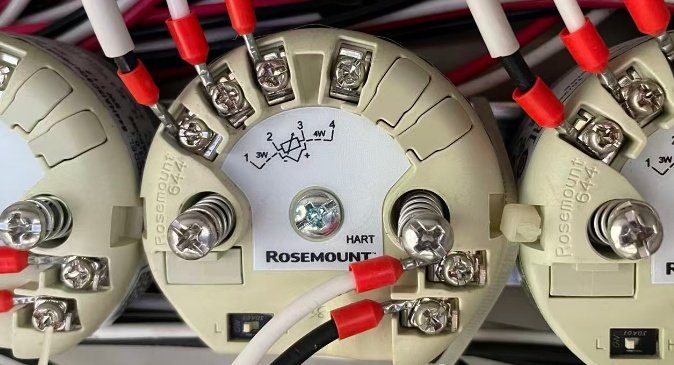
A thermocouple consists of two dissimilar metal wires joined at one end. When the junction heats up, it generates a small voltage (the Seebeck effect). The hotter the junction, the higher the voltage.
- Best for: High-temperature applications above 500 °C, such as furnaces, boilers, and refinery units.
- Common types: Type K (chromel-alumel) for general use; Type S (platinum-rhodium) for extreme temperatures.
📊 RTDs: Resistance Changes
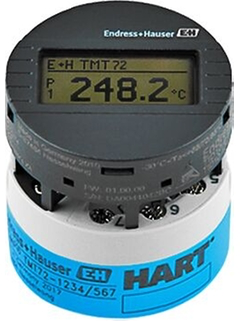
A Resistance Temperature Detector (RTD) uses a pure metal element—most commonly platinum—whose electrical resistance increases predictably with temperature. The industry standard is Pt100, where “Pt” stands for platinum and “100” means 100 ohms of resistance at 0 °C.
- Best for: Precision measurements from -200 °C to 500 °C, common in chemical and pharmaceutical processes.
- Advantage: Higher accuracy and long-term stability than thermocouples in this range.
Signal Conversion Inside the Transmitter
The raw signal from a thermocouple is in millivolts; from an RTD, it is a small resistance change. Neither can travel long distances reliably. The transmitter’s internal circuitry solves this through three stages:
1. Amplification
The input signal is boosted to a level the transmitter can process accurately. This is critical because thermocouple voltages are often in the microvolt range.
2. Linearization
Thermocouple output is not perfectly linear. The transmitter applies a mathematical correction curve so that the final output scales evenly across the measurement range.
3. Standardization
The conditioned signal is converted into a standard industrial output. The most common is the 4-20 mA current loop:
- 4 mA = lower range limit (e.g., 0 °C)
- 20 mA = upper range limit (e.g., 100 °C)
- 12 mA = midpoint (e.g., 50 °C)
🤔 Why 4 mA instead of 0 mA?
In a two-wire loop, the 4 mA baseline powers the transmitter itself. If the signal drops below approximately 3.6 mA, the control system flags a broken wire or sensor failure. This “live zero” makes fault detection automatic.
How the Signal Reaches Your Control System
Once converted to 4-20 mA, the current travels through a two-wire cable to the DCS or PLC input card. Inside the card, a precision resistor (typically 250 Ω) converts the current back to a voltage:
- 4 mA × 250 Ω = 1 V
- 20 mA × 250 Ω = 5 V
The controller reads this voltage, applies the configured range, and displays the corresponding temperature on the operator screen. What you see in the control room is the result of two translations: temperature to current, then current to voltage to digital value.
Field Installation: Integrated vs. Rail-Mounted
Integrated (Head-Mounted) Transmitters
These install directly inside the sensor connection head. The sensor and transmitter form a single assembly.
- Pros: Compact, minimal signal loss, no need for compensation cable.
- Cons: Less convenient for calibration and replacement in hard-to-reach locations.
Rail-Mounted Transmitters
These mount on DIN rails inside junction boxes or control cabinets, separate from the sensor.
- Pros: Easy access for maintenance and configuration.
- Cons: Require extension or compensation cable from sensor to transmitter.
Modern plants increasingly favor integrated transmitters with HART communication. HART overlays digital data on the 4-20 mA line, allowing a handheld communicator like the Emerson AMS Trex or HART 475 to read diagnostics, re-range the device, or check internal temperature without interrupting the analog signal.
🛠️ Troubleshooting: What Failure Looks Like
When a temperature transmitter fails, the DCS usually reveals the pattern:
| Symptom | Probable Cause |
|---|---|
| Signal below 3.6 mA | Open sensor, broken wire, or failed transmitter |
| Signal above 21 mA | Sensor short or transmitter electronics fault |
| Fixed value, no change | Transmitter locked up or in fail-safe mode |
| Erratic, jumping values | Loose terminals, poor shield grounding, or moisture ingress |
💡 Field diagnostic tip: Measure the signal at the transmitter input terminals. If the sensor input is normal but the output is wrong, the transmitter is the culprit. If the input itself is abnormal, check the sensor or extension cable first.
Two-Wire vs. Four-Wire: What Is the Difference?
| Feature | Two-Wire | Four-Wire |
|---|---|---|
| Wiring | Two wires carry power and signal | Two for power, two for signal |
| Power source | Loop-powered from DCS | External power supply |
| Accuracy | Standard industrial grade | Higher precision, lower noise |
| Typical use | Process transmitters, field instruments | Laboratory or analytical instruments |
Most temperature and pressure transmitters in process plants use two-wire loops because they reduce cabling cost and simplify installation.
HART Protocol: Digital Data Over Analog Lines
HART (Highway Addressable Remote Transducer) is a digital communication protocol that rides on top of the 4-20 mA signal. It enables:
- Remote configuration of range, damping, and tag information
- Access to secondary variables such as sensor temperature and loop current
- Device diagnostics and status alerts
A HART communicator sends digital requests at frequencies that do not disturb the analog current. This means you get full digital capability without sacrificing the reliability of a simple current loop.
Related Reading
- Rosemount 3144P Temperature Transmitter: HART Configuration and Troubleshooting Guide
- Temperature Transmitter Configuration and Application: A Complete Technical Guide
- Why 4-20mA is the Universal Language of Industrial Automation
- Endress+Hauser iTHERM ModuLine TM131: Modular Industrial Temperature Sensor
- E+H iTEMP TMT72 Temperature Transmitter Wiring Guide and Troubleshooting Analysis
✅ Key Takeaways
- ▸ Temperature transmitters translate sensor output into a standardized 4-20 mA signal for DCS/PLC integration.
- ▸ Thermocouples suit high temperatures; RTDs like Pt100 offer superior accuracy in lower ranges.
- ▸ The 4 mA live zero enables automatic detection of broken wires and sensor failures.
- ▸ HART protocol adds digital diagnostics without disrupting the analog signal.
- ▸ Field troubleshooting starts at the transmitter terminals: verify input before blaming the sensor.
For technical consultation or genuine replacement transmitters from Rosemount, Endress+Hauser, and other leading brands, contact our application engineers at sales@yunrui-controls.com or WhatsApp 18710784030.