





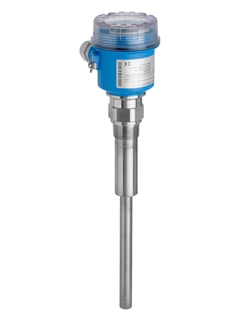
Technical Characteristics and Operational Ease
-
Vibronic Tuning Fork Technology: The sensor’s tuning fork is piezo-electrically driven. When the fork is covered by bulk solids, its vibration frequency is dampened. This change is detected by the electronics and converted into a switching signal. This method is highly reliable and unaffected by flow noises or external vessel vibrations.
-
Plug and Play Commissioning: The FTM20 requires no calibration or on-site adjustment. Once installed, it is ready for immediate operation, making it an ideal “install and forget” solution for standard solids applications.
-
Maintenance-Free Design: With no mechanically moving parts, the FTM20 is immune to the wear, jamming, and breakage common with rotary paddle switches. The 316L stainless steel sensor is naturally abrasion-resistant, even when used with building materials like cement or lime.
-
Visible Status Monitoring: Available with a plastic housing featuring a transparent cover, the device allows the switching status to be checked from the outside at a glance. For more demanding environments, a robust aluminum housing is also available.
-
Resilience to Build-up: The sensor design is specifically shaped to minimize the impact of material build-up, ensuring that the device triggers only when the actual material level reaches the fork.
Technical Specification Matrix
| Feature | Technical Details |
| Measuring Principle | Vibronic (Tuning Fork for Solids) |
| Media Type | Fine to coarse-grained bulk solids (non-fluidized) |
| Process Temperature | -40 to +150 °C (-40 to +300 °F) |
| Process Pressure | -1 to +25 bar (-14.5 to +360 psi) |
| Sensor Material | 316L Stainless Steel |
| Housing Material | Plastic (PBT) or Aluminum |
| Output Signal | DC-PNP, 2-wire AC, Relay |
| Safety & Compliance | ATEX, IECEx, CSA (Dust/Gas ignition protection) |
Primary Applications
-
Building Materials: Reliable level detection for sand, gravel, cement, and lime in silos and hoppers.
-
Food Industry: Monitoring storage bins for grain, sugar, flour, and animal feed.
-
Plastics Industry: Detecting high or low levels of plastic pellets, granules, and regrind.
-
Chemical Industry: Point level detection for non-corrosive chemical powders and catalysts.
-
Wood Processing: Monitoring levels of wood chips and sawdust in collection bunkers.