





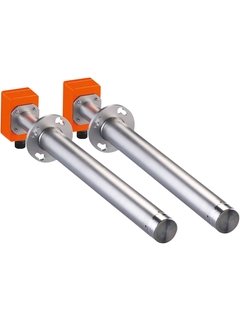
Critical Technical Advantages
-
Optimized for Harsh Emissions: The system utilizes rugged titanium transducers as standard, providing exceptional resistance to corrosion and mechanical wear. This ensures a long service life even when exposed to the abrasive and chemically aggressive gases found in cement or chemical plants.
-
Versatile Installation Variants: The FLOWSIC100 offers diverse configurations to match specific duct geometries. The H, M, and S types perform cross-duct measurement for maximum accuracy in large stacks, while the PR probe version allows for single-sided installation, significantly reducing installation costs and efforts.
-
High-Temperature Capability: The AC (Air Cooled) versions feature an innovative internal cooling system, allowing the sensors to operate in gas streams up to 450 °C. For standard applications up to 260 °C, the device operates reliably without any purge air requirement.
-
Contamination Resistance: For processes involving sticky or wet dust, the purged Px versions use a continuous air flow to keep the sensor faces clean, preventing signal degradation and minimizing maintenance intervals.
-
Automated Operational Checks: The device performs automated zero and reference point tests. This self-monitoring capability ensures high data availability and compliance with environmental regulations by providing documented proof of measurement stability.
-
No Process Interference: The ultrasonic measurement is non-intrusive and creates zero pressure loss. This means the meter does not affect the process draft or increase the energy consumption of the plant’s fan systems.
-
SOPAS ET Software Integration: Users can easily configure, monitor, and diagnose the system using the user-friendly SOPAS ET software, which provides deep insights into the device’s diagnostic health and signal quality.
Detailed Technical Performance Matrix
| Specification | Technical Details and Ranges |
| Measured Variables | Gas velocity, gas volume, sound velocity, gas temperature |
| Measuring Range | 0 to 20 m/s, 0 to 40 m/s, or up to 80 m/s (depending on version) |
| Duct Diameter | 0.1 m to 13 m (depending on type: S, M, H, or PR) |
| Gas Temperature | -40 °C to +260 °C (Standard) / up to +450 °C (AC version) |
| Operating Pressure | -100 hPa to +100 hPa (higher on request) |
| Accuracy | Typically ±2.0% of the measured value |
| Transducer Material | Titanium (Standard), Hastelloy or Stainless Steel (Options) |
| Communication | Modbus, HART, Analog 4-20mA, Relay outputs |
Primary Applications
-
Power Plant Emissions: Monitoring stack flow for legal reporting of pollutants (e.g., SO2, NOx) in coal or gas-fired plants.
-
Cement and Glass Manufacturing: Measuring flow in high-dust environments for process optimization and environmental compliance.
-
Iron and Steel Industry: Tracking gas flow in blast furnaces and coke oven gas lines.
-
Chemical & Hydrocarbon Processing: Monitoring flare or vent stacks where aggressive gas components are present.
-
Waste Incineration: Providing reliable flow data in high-temperature and highly variable gas compositions for regulatory oversight.