








When your application demands corrosion resistance and precise pressure control, the Fisher 1098-EGR and 1098H-EGR series deliver. These pilot-operated regulators feature all-stainless construction (CF8M body) and handle everything from low-pressure gas distribution to high-pressure industrial processes.
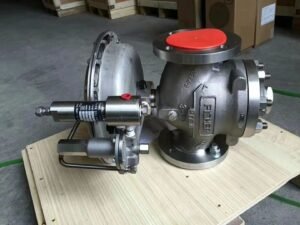
Model Breakdown
| Feature | 1098-EGR | 1098H-EGR |
|---|---|---|
| Body Material | CF8M Stainless Steel | CF8M Stainless Steel |
| Trim Material | Stainless Steel | Stainless Steel |
| Pressure Rating | Standard | High-Pressure Variant |
| Typical Use | General industrial, gas distribution | Severe service, high differential |
Both models share the same modular architecture—choose based on your operating pressure and service conditions.
Technical Specifications
| Specification | Value |
|---|---|
| Size Range | NPS 1″ ~ 12″ (DN25 ~ DN300) |
| End Connections | CL150/300/600 RF Flange, NPT, Butt/Socket Weld |
| Max Inlet Pressure | 400 psig / 27.6 bar |
| Outlet Pressure Range | 10 mbar ~ 20.7 bar (4 in w.c. ~ 300 psig) |
| Minimum Differential | 1 psid / 70 mbar |
| Flow Capacity | Liquid: 45,170 L/min (11,934 gpm)<br>Gas: ~185,000 Nm³/h |
Temperature Limits by Seal Material
Selecting the right elastomer is critical for long-term performance:
| Seal Material | Temperature Range | Best For |
|---|---|---|
| NBR (Nitrile) | -29°C ~ 82°C | Standard gas, oil-based fluids |
| FKM (Viton) | -18°C ~ 149°C | High temperature, chemical resistance |
| EPR (EPDM) | -29°C ~ 135°C | Water, steam, polar solvents |
Tip: FKM seals cost more upfront but eliminate premature failure in hot gas applications.
Key Design Features
1. All-Stainless Internal Components
CF8M body plus stainless trim resists sour gas, corrosive chemicals, and coastal humidity. No internal cast iron parts to corrode.
2. In-Line Maintenance
The clamped body design lets you service the regulator without removing it from the pipeline. Reduce downtime during turnarounds.
3. Low-Differential Precision
Operates reliably with just 1 psi differential. Ideal for tank blanketing, vapor recovery, and other low-pressure-drop services.
4. High-Performance Noise Attenuation
Optional noise-reducing trim cuts aerodynamic noise by up to 30 dBA—critical for urban gas stations and noise-sensitive facilities.
When to Choose 1098-EGR vs 1098H-EGR
Choose 1098-EGR when:
- Inlet pressure ≤ 400 psig
- Moderate pressure differentials
- General gas regulation, tank blanketing, burner fuel supply
Choose 1098H-EGR when:
- High pressure drops across the valve
- Severe service with flashing or cavitation risk
- Frequent pressure cycling or load variations
Typical Applications
| Industry | Application |
|---|---|
| Oil & Gas | Wellhead pressure control, separator regulation |
| Petrochemical | Reactor feed pressure, vapor recovery |
| Power Generation | Fuel gas regulation, HRSG systems |
| LNG | Vaporization pressure control, send-out regulation |
| Industrial Gas | Air separation, cylinder filling stations |
Sizing Considerations
With flow capacity reaching 185,000 Nm³/h gas or 11,934 gpm liquid, the 1098 series handles some of the largest loads in the Fisher regulator portfolio. When sizing:
- Calculate actual flow at minimum and maximum conditions
- Check outlet velocity—keep below 0.3 Mach for gas
- Verify noise levels at high-flow conditions
- Consider future expansion (size up one line if marginal)
Maintenance Advantages
| Feature | Benefit |
|---|---|
| Top-entry trim | Access without breaking flanges |
| Modular pilot system | Swap pilots for different pressure ranges |
| Field-reversible action | Convert fail-open to fail-close in place |
| Standardized parts | Reduce spare parts inventory |
Conclusion
The Fisher 1098-EGR and 1098H-EGR represent the premium tier of industrial pressure regulation. Stainless construction, massive flow capacity, and field-proven reliability make them the default choice for critical services where failure isn’t an option.
Need help sizing for your specific application? Contact our engineering team with your process conditions.