





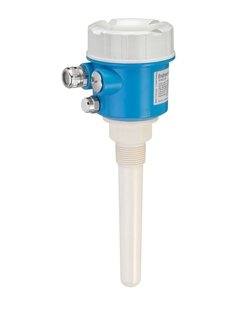
Technical Characteristics and Performance Benefits
-
Active Build-up Compensation: The FTC260 features advanced electronics that automatically identify and compensate for material layers adhering to the sensor probe. This ensures that the switch only triggers when the actual bulk level reaches the probe, preventing false alarms in “sticky” powders like milk powder or gypsum.
-
Mechanical Safety and Long Life: Unlike traditional rotary paddle switches, the FTC260 has no moving parts. This non-mechanical design eliminates the risk of wear, jamming, or motor failure, ensuring a long operating life even in high-vibration applications or with abrasive materials.
-
Universal Material Compatibility: The sensor is optimized for light solids with a dielectric constant $\epsilon_r \geq 1.6$ and a maximum grain size of 30 mm. Its robust PPS (Polyphenylene sulfide) housing offers high resistance to aggressive media and mechanical impact.
-
Calibration-Free Commissioning: Designed for “plug-and-play” utility, the FTC260 requires no complex on-site calibration for the most common materials. This significantly reduces installation time and setup costs.
-
Integrated Protection: To guard against static discharges frequently generated during the rapid filling of dry solids silos, the device includes a multi-stage overvoltage protection system to safeguard the internal electronics.
Technical Specification Matrix
| Feature | Technical Details |
| Measuring Principle | Capacitance (Point Level) |
| Medium Properties | Light solids, $\epsilon_r \geq 1.6$, grain size < 30 mm |
| Sensor Length | 140 mm (5.51″) |
| Process Temperature | -40 to +80 °C (-40 to +176 °F) |
| Process Pressure | -1 to +25 bar (-14.5 to +360 psi) |
| Housing Material | PPS (Polyphenylene sulfide) |
| Output | 3-wire DC-PNP or 2-wire AC |
Primary Applications
-
Food Processing: Monitoring levels in silos for flour, sugar, malt, milk powder, and animal feed.
-
Construction Materials: High-level detection for cement, chalk, gypsum, and fine dry mortar.
-
Plastics Industry: Controlling the fill level in hoppers for plastic pellets or regrind.
-
Bulk Material Handling: Installation in discharge chutes or belt transfer points for blockage detection.
-
Safety and Overfill Prevention: Certified for use in dust-explosion hazardous areas and as a reliable overfill prevention system (WHG).