





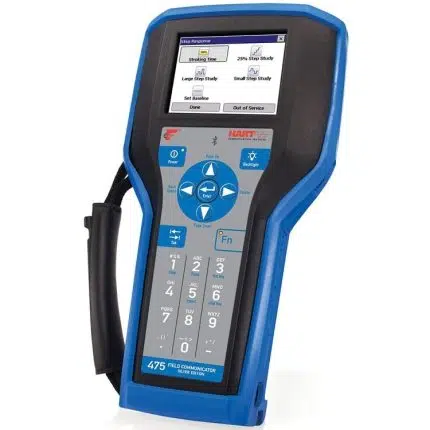
Key Technical Benefits
-
High-Performance Power Management
The P1 designation indicates this unit is equipped with a high-capacity rechargeable Li-ion power module and the corresponding 100-240 VAC power supply/charger. This ensures the device remains operational throughout long shifts in the field with rapid charging capabilities.
-
Enhanced Memory and Graphics (GM)
Featuring 32 MB of high-level memory and a color graphical display, this model allows users to do more than just read text. It supports advanced diagnostics, including the ability to view and analyze complex valve signatures and sensor trends directly at the instrument.
-
Versatile Communication
This configuration is optimized for HART communication, the most widely used protocol in process automation. It provides seamless integration with a vast library of Device Descriptors (DDs) for instruments from Rosemount, Yokogawa, Endress+Hauser, and many others.
-
Rugged and Reliable
Designed for the plant floor, the 475 is built to handle the bumps, drops, and moisture common in industrial settings. The touch screen is designed for high visibility and can be operated with a stylus or fingers.
Model Code Breakdown: 475HP1ENA9GMT
Understanding the specific configuration of the 475HP1ENA9GMT is essential for procurement and technical support:
| Code | Feature | Specification |
| 475 | Base Model | 475 Field Communicator |
| H | Communication | HART Protocol Support |
| P | Power Module | Rechargeable Li-ion Power Module |
| 1 | Power Supply | Power Supply/Charger (100-240 VAC) |
| E | Language | Inglizcha |
| NA | Certifications | No Explosion-Proof Approvals (Safe Area Use Only) |
| 9 | Easy Upgrade | No Easy Upgrade (Standard DD library) |
| GM | Memory | Graphics / 32 MB High-Level Memory |
| T | Display | Touch Screen with Stylus |
Primary Industrial Applications
The 475HP1ENA9GMT is a essential tool for several field tasks:
-
Transmitter Configuration: Adjusting ranges, damping, and units for pressure, temperature, and level transmitters.
-
Loop Testing: Simulating mA signals to verify loop integrity and control system response.
-
Device Diagnostics: Reading error codes and alerts to identify sensor failures or configuration mismatches.
-
Inventory Management: Accessing device tags and serial numbers for asset tracking.