







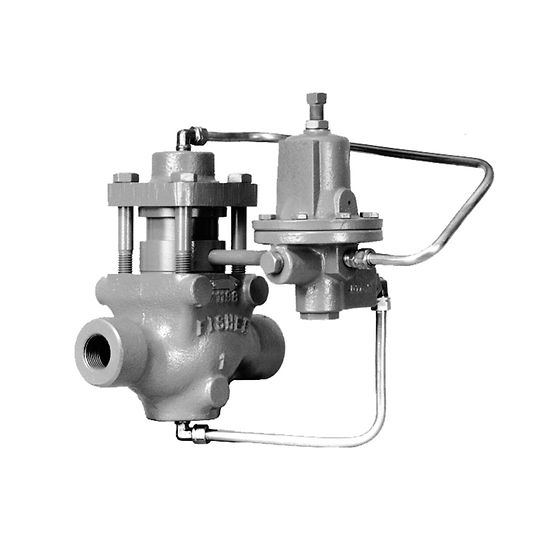
Key Benefits and Advantages
-
High-Cycle Steam Durability: The piston-actuated architecture is designed to withstand the rapid cycling and thermal stresses inherent in steam service, ensuring a longer service life compared to traditional diaphragm-style regulators.
-
Superior Shutoff Integrity: Both the main Type 92S valve and its associated pilots utilize lapped seating surfaces. This precision engineering has been field-proven to minimize seat leakage, effectively controlling downstream pressure buildup during periods of zero demand.
-
Noise Reduction without Capacity Loss: The 92S is designed to manage high-velocity steam flows quietly. Its internal geometry allows for significant noise reduction capabilities without sacrificing the high flow capacity required for industrial headers.
-
Bellows-Sealed Pilots: When used with Type 6492H or 6492L pilots, the system features bellows-sealed stems. This design eliminates stem guide friction, resulting in smoother response and preventing steam leaks at the pilot stem.
-
Extreme Temperature and Pressure Ratings: Available in steel and stainless steel constructions, the 92S can handle temperatures up to 650°F / 343°C and setpoints up to 250 psig / 17.2 bar, making it suitable for high-pressure boiler and process steam systems.
-
Ease of Installation: Despite its heavy-duty performance, the 92S is designed for straightforward installation. Its self-powered nature means it requires no external power source, simplifying piping and reducing installation costs in remote or complex facilities.
Technical Properties
-
Operation: Pilot-operated and piston-actuated.
-
Material Options: Cast Iron, Steel, and Stainless Steel.
-
Maximum Temperature: 650°F / 343°C.
-
Setpoint Range: Up to 250 psig / 17.2 bar.
-
Pilot Compatibility: Works with 6492 Series pilots for varying pressure requirements.
-
Seat Design: Metal-to-metal lapped seating for high-temperature durability.
Field of Application
The 92S is the definitive choice for industrial steam management where precision and high-cycle reliability are paramount. It is a critical component in thermal energy distribution.
Primary Industries and Uses:
-
Power Generation: Pressure reduction for auxiliary steam lines and soot blower systems.
-
Chemical and Refining: Managing high-temperature process steam for reactors and heat exchangers.
-
District Heating: Controlling steam pressure for municipal and campus-wide heating networks.
-
Pulp and Paper: Regulating steam for drying cylinders and pulping processes.