





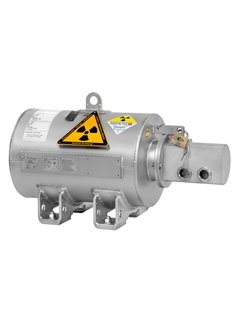
Technical Characteristics and Safety Engineering
-
Maximum Shielding Effectiveness: The FQG66 is engineered to provide extremely high attenuation in all non-measurement directions. This high level of shielding often means that “control areas” (restricted zones) are not required, allowing for installation in areas where plant personnel work regularly.
-
Dual Encapsulation Protection: In addition to the standard source capsule, the FQG66 includes a secondary metallic protective capsule with an O-ring seal. This double-layer protection shields the radioactive source from harsh mechanical impacts and chemical influences.
-
High Activity Capacity: Designed for the most challenging penetration tasks, it can hold sources powerful enough to measure through the thickest reactor walls, internal baffles, and the densest process media.
-
Versatile Emission Angles: To ensure the radiation beam perfectly matches the vessel’s geometry and the detector’s position, the FQG66 offers various emission angles, optimizing the signal-to-noise ratio.
-
Visual and Remote Status Monitoring: The ON/OFF switching status can be verified visually through sight glasses on the cover. For automated safety systems, remote display via proximity switches is also available to monitor the shutter position from the control room.
Technical Specification Matrix
| Feature | Technical Details |
| Application | Point Level, Continuous Level, Density |
| Radioactive Source | $^{137}Cs$ (Cesium) or $^{60}Co$ (Cobalt) |
| Max Activity ($^{137}Cs$) | Up to 740 GBq (20,000 mCi) |
| Max Activity ($^{60}Co$) | Up to 185 GBq (5,000 mCi) |
| Safety Classification | Source typically C66646 (DIN 25426/ISO 2919) |
| Security | Padlock for ON/OFF fixation; theft protection |
| Status Monitoring | Sight glasses or remote proximity switches |
Primary Applications
-
Heavy-Wall Reactors: Continuous level measurement in high-pressure reactors where the steel wall thickness is extreme.
-
High-Density Catalyst Beds: Monitoring levels in petrochemical hydrocrackers or PTA reactors where the medium absorbs massive amounts of radiation.
-
Smelters and Foundries: Non-contact level detection of molten metals or glass in thick-lined furnaces where temperatures and densities are exceptionally high.
-
Nuclear and Power Industries: Critical level and density monitoring in safety-instrumented systems where high-reliability shielding is paramount.
-
Deep-Vessel Interface Detection: Detecting the boundary between layers in very large separators that require high-strength sources to span the diameter.