




Critical Technical Advantages
-
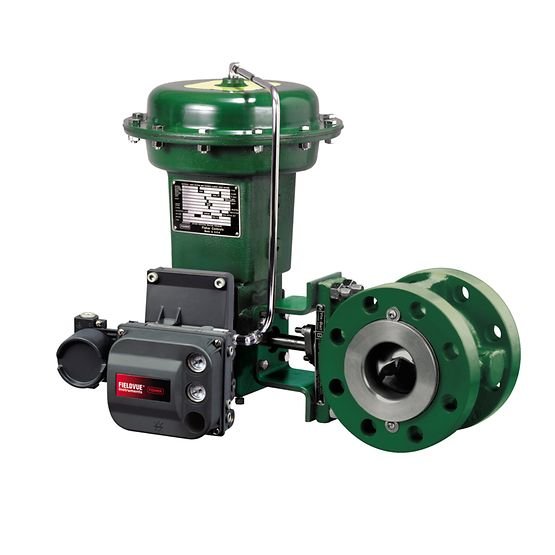
Minimized Lost Motion: The 1052 utilizes a single-joint linkage combined with a splined and clamped lever. This direct-drive architecture minimizes deadband and lost motion, which is critical for high-accuracy throttling applications where small control signals must translate into immediate valve movement.
-
Versatile Mounting Configurations: These actuators support both fail-open and fail-close constructions. They are engineered to be mounted in any of four distinct actuator/valve orientations, allowing for flexible installation in tight piping manifolds or complex skid layouts.
-
Enhanced Safety and Maintenance: The actuator features an externally accessible spring adjuster. This allows maintenance teams to safely relieve spring compression before disassembly. Furthermore, while the actuator/valve linkage is completely enclosed for protection, the valve packing remains accessible for adjustment without removing any components.
-
Over-Pressurization Protection: The rugged casing and yoke construction provide significant structural stability. This design is specifically intended to resist deformation and maintain integrity even in the event of accidental over-pressurization of the diaphragm casing.
-
Broad Compatibility: Although optimized for Fisher rotary valves, the 1052 series was designed with a universal mounting interface, allowing it to be adapted to a wide range of third-party rotary equipment and dampers.
Technical Performance Matrix
| Feature | Details |
| Actuator Type | Spring-Return Rotary Diaphragm |
| Sizes (Legacy) | 20, 30, 33, 40, 60 |
| Action | Fail-Open or Fail-Close (Reversible) |
| Shaft Connection | Splined and Clamped Lever |
| Enclosure | Fully enclosed linkage with packing access |
| Adjustment | Externally accessible spring compression |
Primary Applications
-
Rotary Throttling Control: Managing flow in V-notch ball valves and high-performance butterfly valves.
-
General Utility Isolation: Reliable on/off control for industrial water, air, and steam lines.
-
Legacy Plant Maintenance: Serving as a primary actuation component in facilities built prior to the 1052’s obsolescence.
-
Damper Control: Providing the torque and precision necessary for modulating air flow in large-scale HVAC or combustion systems.