






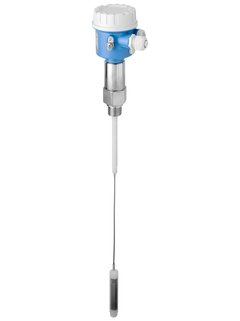
Technical Characteristics and Deep-Vessel Capability
-
Flexible Rope Design: The use of a rope sensor allows for level detection in much taller tanks than a rigid rod probe could accommodate. It is easier to transport and install in areas with low overhead clearance, as the rope can be coiled during transit.
-
Active Build-up Compensation: The FTI52 is engineered to ignore product residue clinging to the rope. This ensures that the switch only triggers when the actual liquid level reaches the sensing element, providing maximum reliability in sticky media like oils, syrups, or resins.
-
Integrated Pump and Two-Point Control: A single FTI52 can manage two-point control (e.g., maintaining a level between a “start” and “stop” point) using just one process connection. This reduces installation costs and the number of tank penetrations required.
-
Durable Materials and Safety: All process-wetted parts are made of corrosion-resistant and FDA-listed materials (316L, PFA, PTFE). With SIL2 certification and WHG overfill prevention, it meets the highest global safety standards for environmental and process protection.
-
Extreme Process Tolerance: Capable of operating in vacuum or high-pressure environments (up to 100 bar) and across a massive temperature range (-80 °C to +200 °C), the FTI52 is suitable for virtually any liquid storage application.
-
Simplified Maintenance: Calibration is achieved at the press of a button. If the electronics module needs replacement, the device does not require recalibration, ensuring minimal downtime.
Technical Specification Matrix
| Feature | Technical Details |
| Measuring Principle | Capacitance (Point Level) |
| Max. Probe Length | Up to 12 m (39 ft) |
| Process Temperature | -80 to +200 °C (-112 to +392 °F) |
| Process Pressure | Vacuum to 100 bar (1,450 psi) |
| Materials (In-process) | 316L, PFA, PTFE (FDA-listed) |
| Output | Relay DPDT, PFM, 3-wire PNP |
| Safety | SIL2, WHG Overfill Prevention |
Primary Applications
-
Tall Storage Silos and Tanks: Point level detection for liquids in large-scale tanks where a rigid rod is impractical.
-
Interface Monitoring in Deep Basins: Detecting the separation layer between conductive and non-conductive liquids (e.g., oil/water interface) in deep separators.
-
Conductive Foam Detection: Identifying foam buildup in large chemical reactors or fermentation tanks to prevent process overflow.
-
Aggressive Media in Large Volumes: Monitoring acids, alkalis, or solvents in tall bulk storage tanks where corrosion resistance is essential.
-
Maritime and Offshore: Reliable high/low level alarms in deep ballast or fuel tanks on ships and offshore platforms.