








This Fisher DVC6200 vs Siemens PS2 comparison examines two of the most specified digital valve positioners in process industries. Both devices deliver precise, intelligent valve control with predictive diagnostic capabilities, but they represent distinct engineering approaches to the same challenge.
Choosing between the Fisher FIELDVUE DVC6200 and Siemens SIPART PS2 impacts process control performance, maintenance costs, and safety system reliability. This guide analyzes both positioners across seven critical dimensions—technical specifications, communication architecture, diagnostic depth, commissioning workflows, modular expansion, environmental adaptability, and total cost of ownership—to provide process engineers with actionable selection criteria.
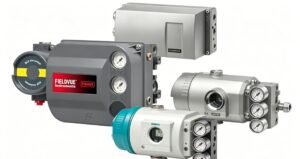
Fisher DVC6200 vs Siemens PS2: Product Architecture and Model Variants
Fisher DVC6200 Family
The DVC6200 series employs a hardware-segmented architecture designed around mounting topology:
- DVC6200: Primary variant for integral mounting on sliding-stem actuators or window-mounting on rotary actuators. The electronics and pneumatic block integrate directly onto the valve assembly.
- DVC6205: Base unit designed for 2-inch pipestand or wall mounting, used in remote-mount configurations where the valve environment exceeds electronics temperature ratings.
- DVC6215: Remote feedback unit paired with the DVC6205, containing the travel sensor and local pneumatic stage while communicating digitally with the base unit over dedicated cable.
Emerson tiers diagnostic capability through four distinct levels rather than hardware variants:
- HC (HART Communicating): Entry-level configuration with standard HART communication, basic alerts, and burst mode transmission.
- AD (Advanced Diagnostics): Adds valve signature capture, step response analysis, drive signal testing, and dynamic error band calculation.
- PD (Performance Diagnostics): Introduces travel/pressure fallback algorithms, supply pressure monitoring, and enhanced alert thresholds.
- ODV (Optimized Digital Valve): Top tier incorporating partial stroke test (PST) calibration for safety instrumented systems, solenoid valve testing, and lead/lag set point filtering for demanding control loops.
Siemens PS2 Family
The PS2 adopts a modular card-based architecture centered on the base article number 6DR5… with pneumatic housing variants indicating actuator compatibility:
- 6DR5..0 / .2 / .3: Pneumatic configurations optimized for specific actuator volumes and action types (single-acting vs. double-acting).
- 6DR5..5 / .6: Alternative pneumatic connection geometries for different flow capacity requirements.
- SIPART PS2 BT: Dedicated Bluetooth-enabled hardware variant supporting wireless commissioning and diagnostics.
Rather than tiering diagnostics through firmware levels, Siemens provides extensive modular expansion through physical option cards:
- Digital I/O Module (DIO-2): Additional discrete inputs and outputs for interlock logic and status signaling.
- Analog Output Module (AOM): 4-20 mA feedback signal for external monitoring systems or analog indicators.
- Analog Input Module (AIM): Secondary analog input channel for external set point or process variable integration.
- Inductive Limit Switches (ILS-2): Non-contact position signaling for end-of-travel confirmation.
- Mechanic Limit Switches (MLS-2): Mechanical snap-action switches for rugged position feedback.
- Internal NCS Module: Non-contact position sensing for applications where mechanical feedback linkages are impractical.
Fisher DVC6200 vs Siemens PS2: Technical Specifications
| Parameter | Fisher DVC6200 | Siemens PS2 |
|---|---|---|
| Input Signal | 4-20 mA DC (HART), digital (FF/PA) | 4-20 mA DC (HART), digital (FF/PA) |
| Min. Control Current | 4.0 mA (3.5 mA without μP restart) | Standard 4-20 mA range |
| Voltage at Terminals | 9.5 V DC (analog), 10 V DC (HART) | Standard loop-powered |
| Actuator Media | Instrument air (standard) | Instrument air or natural gas |
| Communication | HART, Foundation Fieldbus, Profibus PA | HART, FF, Profibus PA, Bluetooth |
| Configuration Tools | 475 HART communicator, AMS, ValveLink | SIMATIC PDM, SITRANS DTM, Mobile IQ app |
| Auto-Initialization | Yes (linear and rotary) | Yes (core commissioning feature) |
| Remote Mount | DVC6205 base + DVC6215 feedback | External NCS sensors, transmitters |
| Diagnostic Tiers | 4 levels (HC/AD/PD/ODV) | Standard + modular expansion |
| Limit Switches | Integrated (ODV tier) | Modular (ILS-2/MLS-2 options) |
Communication Protocols: Fisher DVC6200 vs Siemens PS2
Both positioners support the three dominant industrial communication standards: HART (Highway Addressable Remote Transducer), Foundation Fieldbus (FF), and Profibus PA. This protocol breadth ensures compatibility with major DCS platforms including Honeywell Experion, Yokogawa CENTUM, Emerson DeltaV, and Siemens PCS 7.
HART Implementation
The DVC6200 operates as a HART 5/6/7 compatible device with device type 1309, hardware revision 2, and firmware revision 7. It supports burst mode communication for continuous variable transmission and allows multi-drop network configuration when analog control is not required.
The PS2 HART variant implements firmware version 5.06.00, device revision 8, and EDD version 25.00.00. Siemens emphasizes seamless integration with SIMATIC PDM (Process Device Manager) version 9.0 or higher, providing a unified configuration environment for Siemens instrumentation assets.
Digital Protocols
For Foundation Fieldbus, the DVC6200 supports standard function blocks including analog input (AI), analog output (AO), proportional-integral-derivative (PID), and signal characterizer (CHAR). The PS2 FF variant runs firmware 3.01.00 with device revision 3, integrating through SITRANS DTM framework.
Profibus PA implementations on both devices support cyclic data exchange with class 1 masters and acyclic parameterization through class 2 masters. The DVC6200 integrates natively with Emerson’s AMS Device Manager, while the PS2 aligns with SIMATIC PDM and SITRANS DTM V4.x.
The Bluetooth Differentiator
The SIPART PS2 BT variant introduces a paradigm shift in field configuration. Using the SITRANS Mobile IQ app (version 4.02 or higher), technicians can:
- Perform complete device configuration without wired connections
- Run diagnostic routines while standing beside the valve
- Generate PDF commissioning reports directly from smartphones
- Access device documentation and troubleshooting guides offline
The DVC6200 requires either a 475 HART communicator, AMS Trex device communicator, or a laptop with HART modem and ValveLink software. While these tools offer deeper diagnostic analysis, they add hardware cost and require technicians to carry additional equipment.
Diagnostic Capabilities: Fisher DVC6200 vs Siemens PS2
Fisher DVC6200 Diagnostic Architecture
Emerson’s tiered diagnostic system provides progressive capability depth:
HC Tier (HART Communicating) delivers fundamental health monitoring:
- Travel deviation alerts (set point vs. actual position)
- Drive signal saturation warnings
- Supply pressure low/high notifications
- Configuration change logging
AD Tier (Advanced Diagnostics) introduces valve signature analysis—a graphical representation of valve friction, spring rate, and seat load characteristics. Engineers can compare current signatures against baselines to detect packing degradation, seat wear, or actuator diaphragm issues before they cause process upsets.
Step response testing measures valve dynamic performance by commanding step changes and analyzing response time, overshoot, and settling characteristics. Drive signal testing isolates electrical vs. mechanical issues by commanding full output regardless of position feedback.
PD Tier (Performance Diagnostics) adds intelligent fallback algorithms. If travel feedback fails, the positioner can switch to pressure-based control, maintaining approximate valve position using actuator pressure relationships. Supply pressure monitoring tracks air compressor performance and detects leaks in the pneumatic supply system.
ODV Tier (Optimized Digital Valve) addresses safety instrumented system requirements through partial stroke testing (PST). Rather than fully closing a valve (which may disrupt production), PST moves the valve 10-15% of its travel to confirm it can move from its normal operating position. The ODV tier calibrates PST parameters to ensure sufficient movement for meaningful testing without process impact.
Solenoid valve testing verifies proper operation of emergency shutdown solenoids by momentarily de-energizing them and confirming valve movement. Lead/lag set point filtering smooths control signals in noisy or oscillatory loops.
Siemens PS2 Diagnostic Approach
The PS2 provides comprehensive standard diagnostics through continuous monitoring:
- Deviation monitoring between set point and actual position
- Static friction detection through movement analysis
- Pneumatic leak detection via air consumption trending
- Valve seat tightness inference from closure behavior
- Self-monitoring of electronics and pneumatic components
Where the PS2 diverges from the DVC6200 is in modular expansion capability. Rather than purchasing a higher-tier firmware license, users add physical modules:
The Analog Output Module (AOM) provides a 4-20 mA signal proportional to valve position for external monitoring systems, DCS trend recorders, or analog indicators in local control rooms.
Limit switch modules (ILS-2 and MLS-2) provide discrete position confirmation for safety interlocks, pump protection, or sequence control. Inductive switches offer non-contact reliability for high-cycle applications, while mechanical switches provide positive confirmation in safety-critical loops.
The Digital I/O Module (DIO-2) expands discrete channel count for complex interlock logic, allowing the positioner to participate in safety sequences without external relays.
Field Commissioning: Fisher DVC6200 vs Siemens PS2
Auto-Initialization Workflows
Both positioners offer automatic initialization for linear and rotary actuators, but implementation philosophies differ.
The DVC6200 auto-calibration determines:
- Valve travel direction (direct vs. reverse acting)
- Mechanical travel limits (zero and span)
- Seat load at closed position
- Bench set (spring preload) for sliding-stem valves
- Optimized gain and damping parameters
Technicians can override auto-detected parameters for special applications, such as split-ranging (two valves on one controller output) or custom characterization curves.
The PS2 emphasizes its initialization as a core differentiator. The process automatically detects:
- Actuator travel stops (mechanical limits)
- Actuator action (single-acting vs. double-acting)
- Valve direction (air-to-open vs. air-to-close)
- Optimal control parameters (proportional band, derivative time)
Siemens documentation highlights that initialization completes without manual parameter entry, reducing commissioning time and technician skill requirements.
Manual Tuning and Advanced Configuration
For applications where automatic tuning proves insufficient, both devices offer manual tuning modes. The DVC6200 provides detailed tuning parameters including proportional gain, velocity gain, minor loop feedback, and dead band compensation. ValveLink software offers graphical tuning interfaces with real-time response plotting.
The PS2 offers manual initialization modes for both linear and part-turn actuators when automatic detection is impractical—such as with handwheels locked, bypass lines open, or process conditions preventing full travel.
Mobile vs. Traditional Configuration
The PS2 BT variant’s SITRANS Mobile IQ app represents a generational shift. Technicians carry smartphones rather than dedicated communicators. Configuration changes sync through Bluetooth Low Energy, maintaining security while eliminating cable connections. The app supports offline operation, storing device profiles for batch configuration of identical valves.
The DVC6200 maintains traditional configuration pathways. While Emerson offers mobile solutions through AMS Trex, these remain expensive dedicated devices rather than consumer smartphone apps.
Environmental Adaptability: Fisher DVC6200 vs Siemens PS2
Natural Gas Operation
The PS2 explicitly supports natural gas as actuator medium—a critical capability for natural gas pipeline applications, compressor stations, and city gate stations. Using pipeline gas as actuator supply eliminates separate instrument air systems, reducing infrastructure cost and maintenance. The positioner’s materials and seals are specified for natural gas compatibility.
The DVC6200 operates with standard instrument air. While natural gas adaptation is possible through special ordering, it is not a standard catalog offering.
Corrosive and Dusty Environments
The PS2 includes a purge air switching function for harsh environments. By introducing clean purge air into the positioner housing, internal pneumatic components remain protected from corrosive atmospheres, dust, or sand. This feature extends service life in offshore platforms, desert installations, and chemical plants.
The DVC6200 addresses harsh environments through enclosure ratings (NEMA 4X, IP66) and material selections (stainless steel, epoxy coatings) but does not feature integrated purge air control.
Remote Mounting for Extreme Temperatures
Both families support remote mounting where valve temperatures exceed electronics ratings. The DVC6205/DVC6215 combination separates electronics from the valve by up to 300 feet using digital communication. The PS2 achieves similar separation through external NCS sensors and position transmitters with M12 connector options for tool-less maintenance.
Total Cost of Ownership: Fisher DVC6200 vs Siemens PS2
Initial Acquisition Cost
Base-model pricing is competitive between both families. However, capability expansion follows different cost models:
The DVC6200 requires upfront diagnostic tier selection. Upgrading from HC to ODV after purchase typically requires hardware replacement or factory recalibration. Engineers must predict diagnostic needs at specification time.
The PS2 allows incremental capability addition. A base HART unit can receive DIO modules, limit switches, or analog outputs as needs evolve. This pay-as-you-grow model reduces initial capital expenditure but may increase lifetime cost if many modules are added.
Commissioning and Maintenance Labor
The PS2’s auto-initialization and Bluetooth configuration reduce technician time during commissioning. For plants with hundreds of valves, these savings compound significantly.
The DVC6200’s deeper diagnostics reduce unplanned maintenance through earlier failure detection. Valve signature trending identifies degradation months before functional failure, allowing scheduled maintenance during turnarounds rather than emergency shutdowns.
Spare Parts and Inventory
The DVC6200’s modular internal design (pneumatic block, electronics module, feedback assembly) allows field-replaceable units, reducing spare parts inventory. The PS2’s option card architecture similarly supports modular replacement.
Fisher DVC6200 vs Siemens PS2: Selection Decision Matrix
🎯 Choose Fisher DVC6200 When:
- Advanced predictive diagnostics and valve health trending are priorities
- Partial stroke testing (PST) is required for SIL-rated safety instrumented systems
- Your plant standardizes on Emerson AMS Device Manager and ValveLink
- Deep integration with Fisher control valve portfolios is valued
- Valve signature analysis and dynamic error band testing are specified
- You need solenoid valve testing for emergency shutdown validation
🎯 Choose Siemens PS2 When:
- Wireless Bluetooth configuration and smartphone-based commissioning are preferred
- Modular I/O expansion and limit switch integration are required
- Natural gas actuator medium is specified (pipeline applications)
- Purge air protection is needed for corrosive or dusty environments
- Your control system integrates with SIMATIC PDM
- Technician mobility and reduced commissioning time are valued
- Pay-as-you-grow capability expansion aligns with budget cycles
Fisher DVC6200 vs Siemens PS2: Conclusion
The Fisher DVC6200 vs Siemens PS2 comparison reveals two mature, field-proven digital valve positioner platforms with distinct engineering philosophies. The DVC6200 delivers deeper embedded diagnostics and predictive maintenance capability, making it the preferred choice for critical process applications, safety instrumented systems, and plants prioritizing asset reliability. Its tiered diagnostic architecture provides progressive capability depth unmatched in embedded functionality.
The Siemens PS2 offers superior configurability, wireless mobility, and modular expansion. Its Bluetooth commissioning, natural gas compatibility, and option card architecture address applications where flexibility, technician efficiency, and environmental adaptability drive selection criteria.
Both Fisher and Siemens positioners are available from YUNRUI with application engineering support, technical consultation, and genuine stock availability.
📞 Technical Support & Ordering
Email: sales@yunrui-controls.com
WhatsApp: +86 187 1078 4030
Web: www.yunrui-controls.com
Frequently Asked Questions
Can the Fisher DVC6200 and Siemens PS2 be used interchangeably?
Both positioners serve the same fundamental function—intelligent valve control—but they are not direct drop-in replacements. Mounting kits, communication protocols, and configuration software differ. Plants standardizing on one ecosystem should maintain consistency for spare parts and technician training.
Which positioner is better for safety instrumented systems (SIS)?
The Fisher DVC6200 ODV tier is specifically designed for SIS applications with partial stroke testing (PST), solenoid valve testing, and SIL-capable diagnostics. The PS2 can participate in safety loops but lacks the embedded PST calibration found in the DVC6200 ODV.
Does the Siemens PS2 require a smartphone for configuration?
No. The PS2 configures through traditional wired methods using SIMATIC PDM or SITRANS DTM. The Bluetooth variant (PS2 BT) adds smartphone configuration as an option, not a requirement.
Can the DVC6200 diagnose valve packing degradation?
Yes. The AD tier and above provides valve signature analysis, which detects changes in friction profiles indicative of packing degradation, seat wear, or actuator diaphragm issues.
Which positioner has lower total cost of ownership?
For plants with few valves and limited diagnostic needs, the PS2’s lower initial cost and Bluetooth commissioning reduce TCO. For critical applications with hundreds of valves, the DVC6200’s predictive diagnostics reduce unplanned shutdowns, often justifying higher upfront investment.
Related Reading
- Fisher DVC6200/DVC2000 Feedback Signal Troubleshooting: 3 Common Field Problems and Solutions
- Valve Positioner Complete: Working Principles + Field Troubleshooting
- Control Valve Accessories Guide: Positioners, Filter Regulators & More
- Fisher 67CFR Filter Regulator: Complete Troubleshooting, Repair & Parts Guide
- Fisher FIELDVUE 4400 Smart Position Transmitter: Technical Whitepaper and Application Guide