





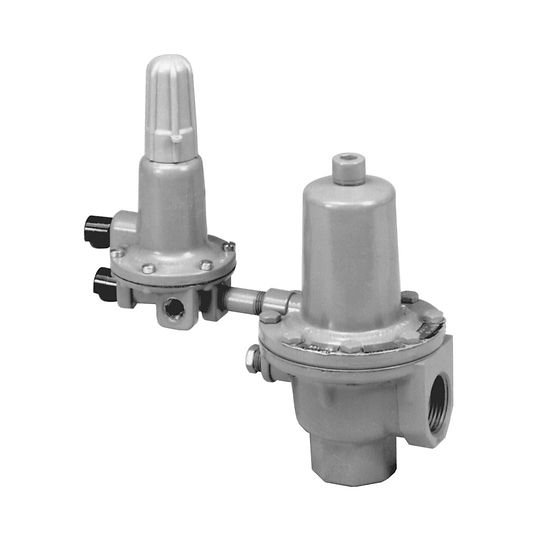
Key Benefits and Advantages
-
High Relief Capacity with Low Buildup: One of the primary advantages of the 289P is its ability to reach full opening capacity with very little pressure increase over the setpoint. This ensures maximum protection for low-pressure systems that cannot tolerate significant overpressure spikes.
-
Fast Reseat After Operation: Once the overpressure condition is cleared, the 289P is designed to reseat quickly and tightly. This minimizes the loss of gas and ensures the system returns to normal operating status immediately after a relief event.
-
Smooth Opening Action: The pilot-operated mechanism provides a controlled, smooth opening sequence. This prevents secondary pressure surges in the system that can occur with the “snap-action” typical of some direct-operated relief valves.
-
Accurate External Pressure Registration: The use of an external control line allows the regulator to sense pressure directly from the downstream piping. This provides faster and more accurate registration, ensuring the valve reacts precisely to the actual system pressure rather than turbulence at the valve inlet.
-
Economical Protection: The 289P offers a cost-effective solution for high-capacity relief. Its efficient design provides the performance of much larger, more expensive valves in a more compact and manageable footprint.
-
Rugged Construction and Corrosion Resistance: Built for long-term outdoor service, the 289P features a durable body and corrosion-resistant fasteners. This makes it ideal for use in district regulating stations and industrial gas skids where exposure to the elements is constant.
-
Ease of Maintenance: The valve is designed for straightforward field service. The pilot and main valve components are easily accessible, allowing for routine inspections and parts replacement without extensive system downtime.
Technical Properties
-
Operation: Pilot-operated relief or backpressure.
-
Media: Natural gas, Air, Propane, and other non-corrosive gases.
-
Connections: Available in standard NPT threaded sizes, typically 1-inch and 2-inch.
-
Setpoint Range: Adjustable via the pilot spring to match the specific relief requirements of the system.
-
Accuracy: High sensitivity due to the pilot-actuated diaphragm.
-
Build Materials: Cast iron or steel body options with specialized elastomers for tight shutoff.
Field of Application
The Type 289P is a vital safety component used to prevent equipment damage and ensure personnel safety in gas handling facilities.
Primary Industries and Uses:
-
District Regulating Stations: Providing secondary overpressure protection for municipal gas networks.
-
Industrial Gas Headers: Protecting low-pressure burners and boilers from upstream regulator failure.
-
Farm Tap Installations: Ensuring safe relief for small-scale gas take-offs from high-pressure transmission lines.
-
Compressed Air Systems: Acting as a high-capacity safety relief valve for large industrial air receivers and manifolds.